
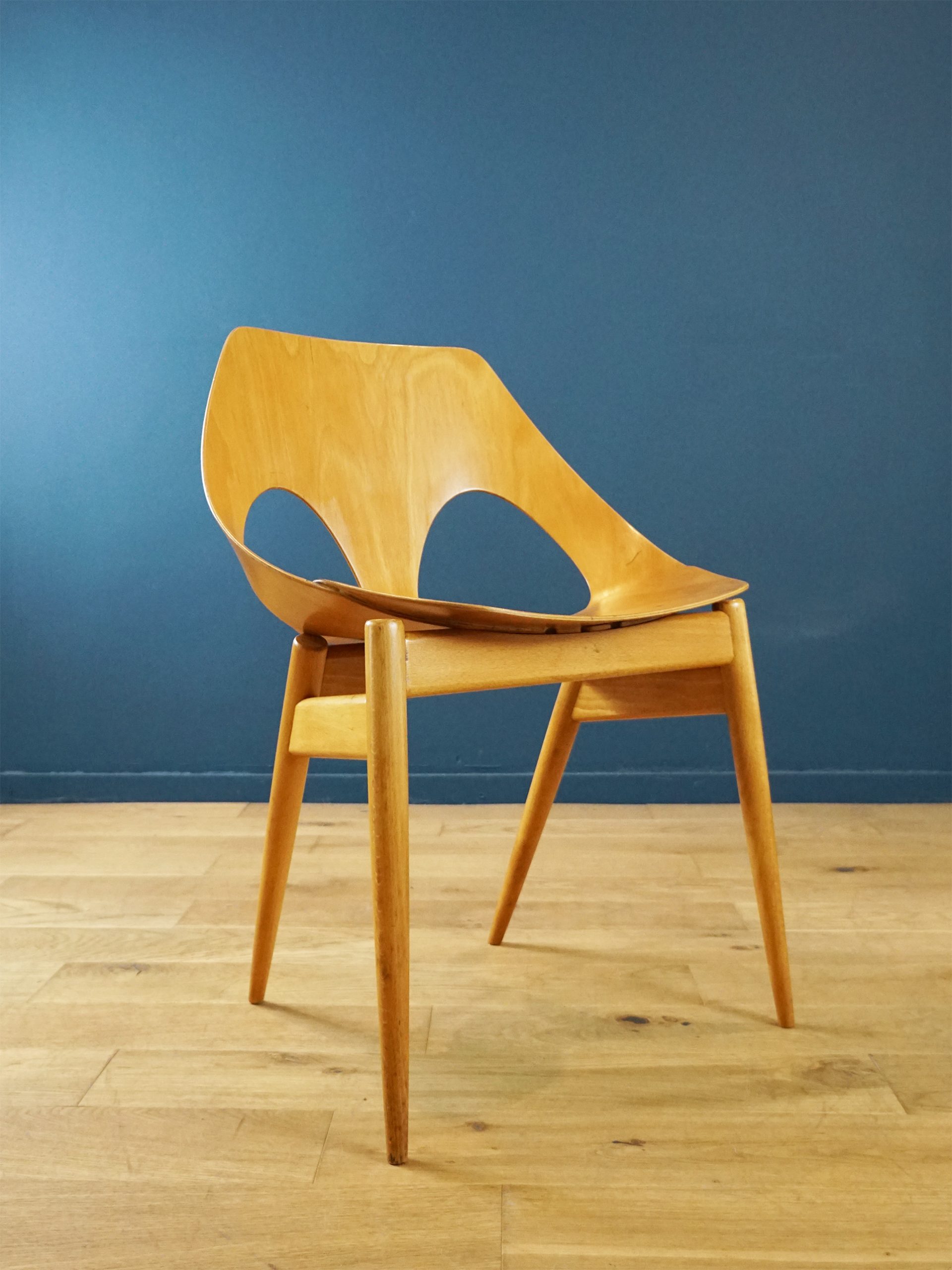
To modern eyes, the ‘Jason’ chair can appear remarkably simple. In the early 1950s, however, the thinking behind it was anything but that. Designed by Danish architect Carl Jacobs and manufactured in Britain by Kandya, its seat and back were formed from a single, impossibly thin, flat sheet of flexible plywood, cut, bent and interlocked to create an extraordinarily economical three-dimensional structure.
Bent plywood itself was not new at the time. Designers had already explored its possibilities, and around the same period chairs such as Arne Jacobsen’s Ant used layers of veneer glued and moulded under pressure to create rigid curved shells. The Jason approached the material differently. Rather than moulding plywood permanently into its finished form, Jacobs exploited the flexibility of a thin flat sheet. Its carefully calculated shape allows it to bend around itself, with the two sides meeting and interlocking beneath the seat. The resulting curves give the material strength and rigidity while retaining enough flexibility to make the chair almost inconceivably comfortable.
That achievement becomes even more impressive when considered in the context of how furniture was designed at the time. Today, a shape like this could be developed using computer-aided design, adjusted repeatedly on screen and transferred directly to CNC machinery for precise cutting. Jacobs had no such tools. The relationship between a flat sheet and the complex three-dimensional form had to be conceived, drawn and ultimately proven through multiple physical prototypes. Every curve and cut had consequences, and even the distinctive openings in the back were carefully resolved to allow another chair to pass through them when the chairs were stacked.
This is perhaps what makes the C2 Jason so fascinating. Its complexity almost completely disappears once the chair is assembled. The wooden frame is similarly restrained, leaving the sweeping plywood form to do most of the visual and structural work. What appears at first to be an extremely simple chair is actually an ingenious piece of engineering, using remarkably little material and including almost nothing without purpose. At a time when much British furniture still relied upon relatively conventional construction, the Jason must have appeared strikingly modern.
The design also captures something particularly interesting about post-war furniture. New materials and manufacturing techniques were allowing designers to reconsider what familiar objects needed to be. A chair no longer necessarily required a conventionally constructed seat and separate back. Jacobs instead treated a flat sheet almost as if it were a textile, cutting and folding it until the material itself became the structure. The Jason’s apparent simplicity was not the absence of design, but the result of an unusually complex design problem being resolved with remarkable clarity.
This particular C2 retains its older, less commonly encountered white Kandya label, another small but important part of the chair’s originality. Its original surfaces, marks and signs of use remain, a testament to both the quality of its construction and the longevity of a design now more than seventy years old. Rather than erase that history, the chair has simply been carefully cleaned and polished, allowing the original wood to shine again. Sometimes preservation means knowing when restoration is necessary. Just as importantly, it means knowing when to leave a remarkable piece of design alone.