
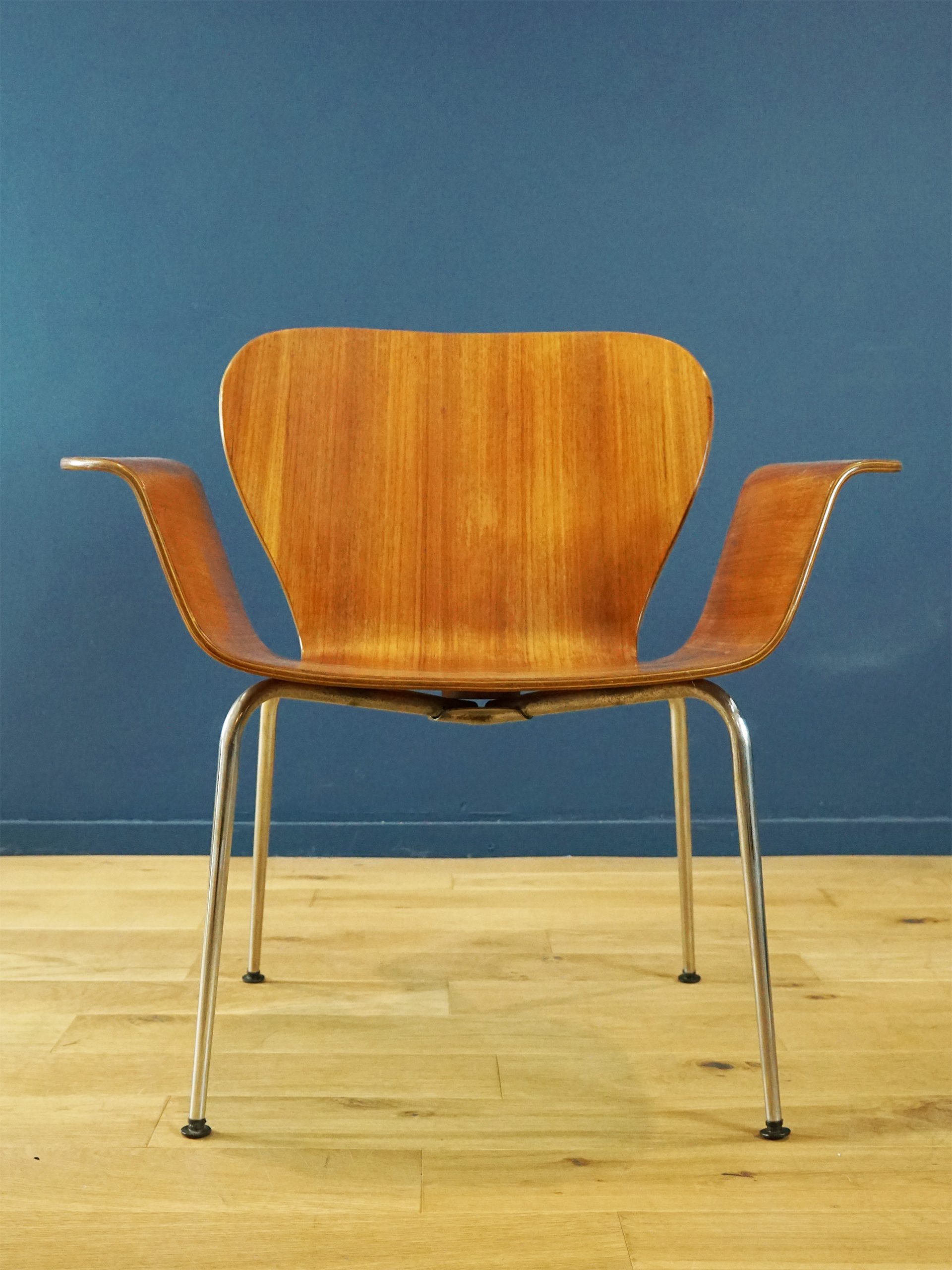
Some pieces of mid-century furniture come with a well-documented history. Others remain surprisingly elusive. The Focus lounge chair, designed by A. Belokopytoff for Westnofa in the 1950s, falls firmly into the latter category. Despite its unmistakable presence, remarkably little appears to have been recorded about its designer.
The chair emerged during an important period for Norwegian furniture design. Westnofa was established in 1955 as a collaborative export organisation, bringing together Norwegian furniture manufacturers that individually lacked the scale to develop substantial overseas markets. As Scandinavian design gained international recognition, Westnofa helped take Norwegian furniture to a much wider audience.
The Focus demonstrates why that furniture attracted attention. Its dramatic shell is constructed from bent plywood with a teak veneer, apparently floating above an exceptionally slender chromed steel frame. The plywood sweeps from the broad back into two pronounced arms, creating an unusually sculptural form from relatively simple materials. The slight flexibility of the plywood also gives the back a gentle spring, making the chair considerably more comfortable than its uncompromising appearance might suggest.
There is also something intriguing about how little we know. Belokopytoff’s name appears repeatedly alongside the small number of surviving Focus chairs that surface today, yet reliable biographical information about the designer is remarkably difficult to find. Unlike many celebrated Scandinavian designers of the period, his wider body of work remains largely undocumented. Surviving examples of the Focus itself appear remarkably infrequently, adding to the sense that this is a distinctive design that has somehow remained on the fringes of the better-known story of Scandinavian modernism.
Perhaps that combination of rarity and obscurity makes the Focus more interesting. Unlike many Scandinavian designs whose histories have been documented and reproduced endlessly, this is a chair that largely has to speak for itself. Its sweeping plywood form, delicate chrome structure and generous proportions are evidence of an ambitious piece of 1950s design. That so few examples seem to appear on the market today makes surviving chairs particularly interesting, not simply as collectible objects, but as evidence of a much less familiar strand of Norwegian mid-century furniture.
This particular example eventually found a suitably interesting new home. After leaving Casta Blue, it was acquired by the Landmark Trust, the conservation charity responsible for some of Britain’s most remarkable historic buildings. There is something rather fitting about a rare piece of 1950s Norwegian design continuing its life with an organisation dedicated to preserving significant buildings and their interiors for future generations.