
One of the things we enjoy most about sourcing vintage furniture and interiors is that the story rarely ends when the purchase is made.
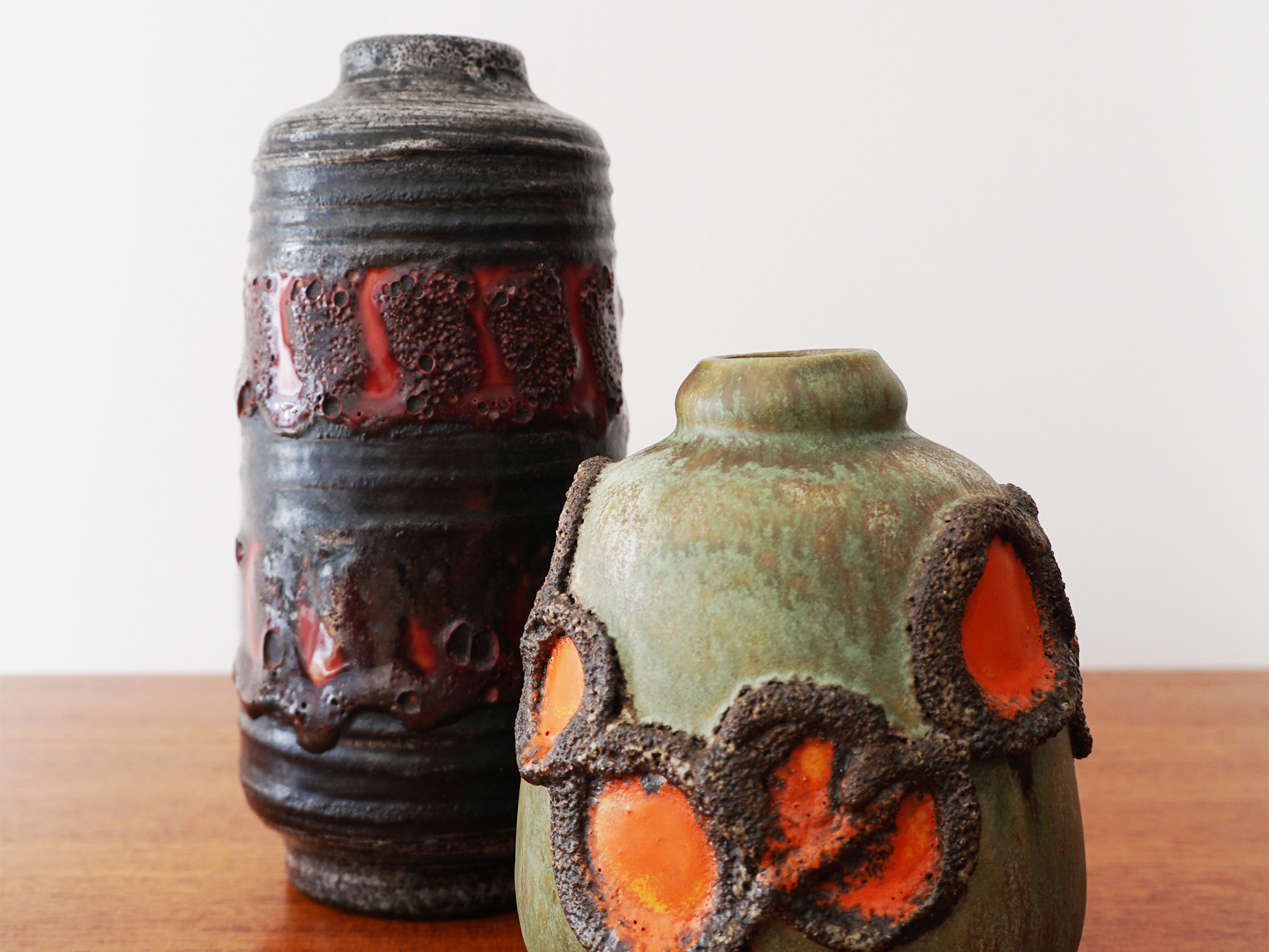
These two ceramic vases were discovered during a recent trip to Lisbon. Bought together from a vintage dealer who told us they had come from the same source, they initially appeared to be a typical pair of 1970s Fat Lava ceramics. It was only when we started researching them that the story became far more interesting.
What is Fat Lava?
Fat Lava is the collector’s term commonly used to describe a style of ceramic production that flourished during the 1960s and 1970s. Characterised by heavily textured glazes, volcanic surfaces and bold colours, Fat Lava pottery became one of the defining design movements of post-war Europe.
Most collectors immediately associate Fat Lava with West Germany, where factories such as Scheurich, Bay Keramik and Carstens produced millions of pieces for export across Europe and beyond.
But the story is slightly more complicated than that.
The East German Vase
The smaller of the two vases carries an East German export mark on the base.
This was an unexpected discovery. Like many people, we had always associated Fat Lava almost exclusively with West German production. Yet during the Cold War years, factories in East Germany were also producing ceramics for export markets across Europe.
The vase bears the mark of Strehla, an East German pottery manufacturer that exported extensively during the 1960s and 1970s. While separated by the Iron Curtain, East German factories still sold goods abroad in order to earn valuable foreign currency.
As a result, East German ceramics found their way into homes across Europe, where they often sat alongside pieces from West Germany with little thought given to the political divide that existed at the time.
The Mystery Vase
The taller vase remains something of a puzzle.
Its dramatic red and black volcanic glaze is unmistakably of the period. The form, proportions and surface texture place it firmly within the Fat Lava tradition, yet the unusual raised marks on the base do not match anything we have encountered before.
Research suggests it is likely German, and quite possibly West German, but the manufacturer remains uncertain. The raised symbols appear to be moulded into the base rather than added as a conventional pattern number, making identification difficult.
Sometimes vintage objects give up their secrets quickly. Sometimes they don’t.
Why We Love Vintage
There is a tendency to think that sourcing vintage is simply a matter of buying and selling objects.
In reality, it is often an ongoing process of discovery.
A pair of vases purchased because they looked good together became a small lesson in Cold War history, European manufacturing and the way design crossed political borders during a divided era.
Whether these two pieces originally sat side by side in a Lisbon home or only met later in life, we’ll probably never know.
What we do know is that nearly fifty years after they were made, they are still provoking questions, starting conversations and reminding us why vintage objects are often far more interesting than new ones.