Author: castablue

  • The Mysterious Focus Chair by A. Belokopytoff

    The Mysterious Focus Chair by A. Belokopytoff

    Some pieces of mid-century furniture come with a well-documented history. Others remain surprisingly elusive. The Focus lounge chair, designed by A. Belokopytoff for Westnofa in the 1950s, falls firmly into the latter category. Despite its unmistakable presence, remarkably little appears to have been recorded about its designer.

    The chair emerged during an important period for Norwegian furniture design. Westnofa was established in 1955 as a collaborative export organisation, bringing together Norwegian furniture manufacturers that individually lacked the scale to develop substantial overseas markets. As Scandinavian design gained international recognition, Westnofa helped take Norwegian furniture to a much wider audience.

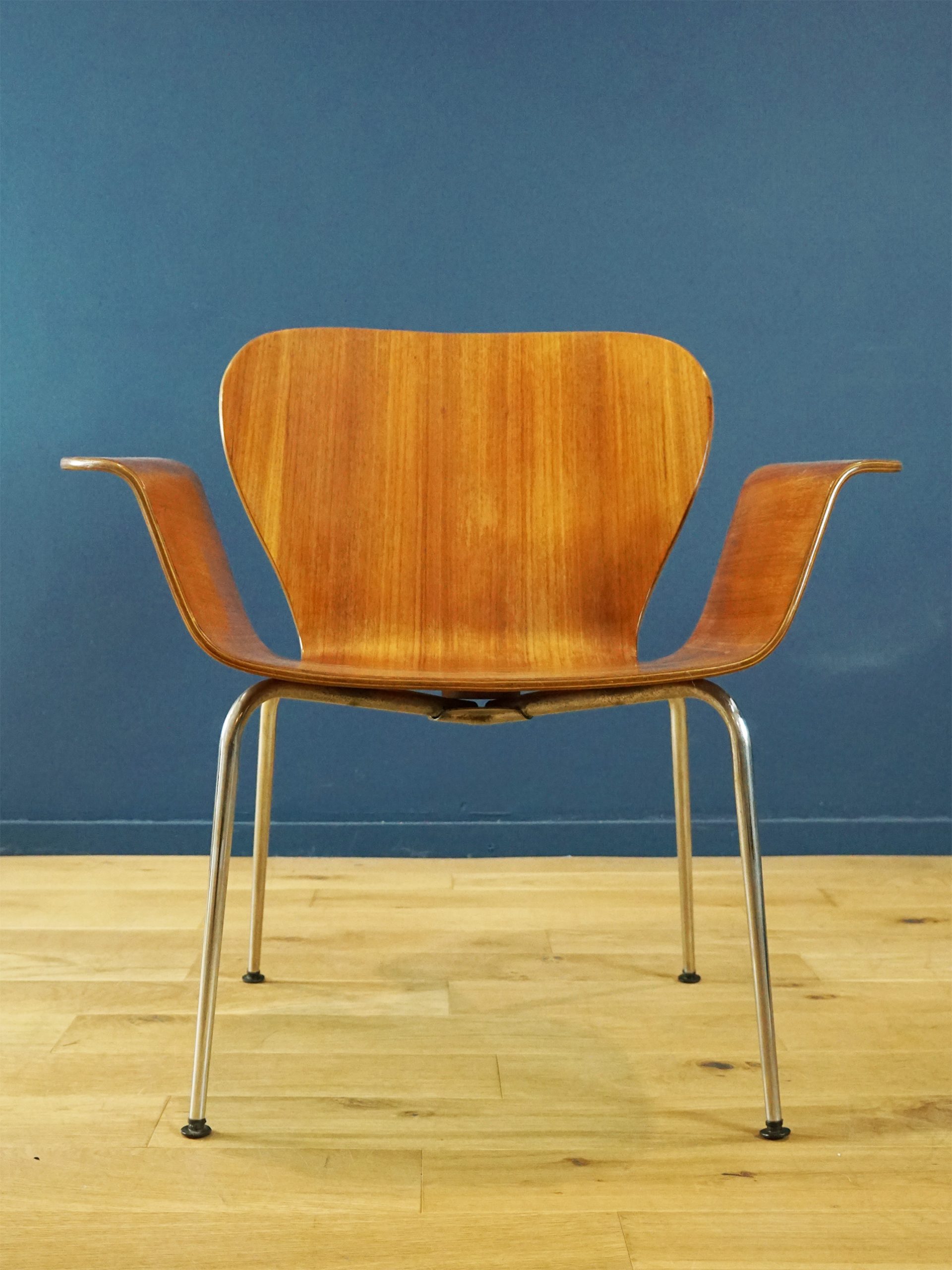
    The Focus demonstrates why that furniture attracted attention. Its dramatic shell is constructed from bent plywood with a teak veneer, apparently floating above an exceptionally slender chromed steel frame. The plywood sweeps from the broad back into two pronounced arms, creating an unusually sculptural form from relatively simple materials. The slight flexibility of the plywood also gives the back a gentle spring, making the chair considerably more comfortable than its uncompromising appearance might suggest.

    There is also something intriguing about how little we know. Belokopytoff’s name appears repeatedly alongside the small number of surviving Focus chairs that surface today, yet reliable biographical information about the designer is remarkably difficult to find. Unlike many celebrated Scandinavian designers of the period, his wider body of work remains largely undocumented. Surviving examples of the Focus itself appear remarkably infrequently, adding to the sense that this is a distinctive design that has somehow remained on the fringes of the better-known story of Scandinavian modernism.

    Perhaps that combination of rarity and obscurity makes the Focus more interesting. Unlike many Scandinavian designs whose histories have been documented and reproduced endlessly, this is a chair that largely has to speak for itself. Its sweeping plywood form, delicate chrome structure and generous proportions are evidence of an ambitious piece of 1950s design. That so few examples seem to appear on the market today makes surviving chairs particularly interesting, not simply as collectible objects, but as evidence of a much less familiar strand of Norwegian mid-century furniture.

    This particular example eventually found a suitably interesting new home. After leaving Casta Blue, it was acquired by the Landmark Trust, the conservation charity responsible for some of Britain’s most remarkable historic buildings. There is something rather fitting about a rare piece of 1950s Norwegian design continuing its life with an organisation dedicated to preserving significant buildings and their interiors for future generations.
  • The Deceptive Simplicity of the Carl Jacobs ‘Jason’ Chair

    The Deceptive Simplicity of the Carl Jacobs ‘Jason’ Chair

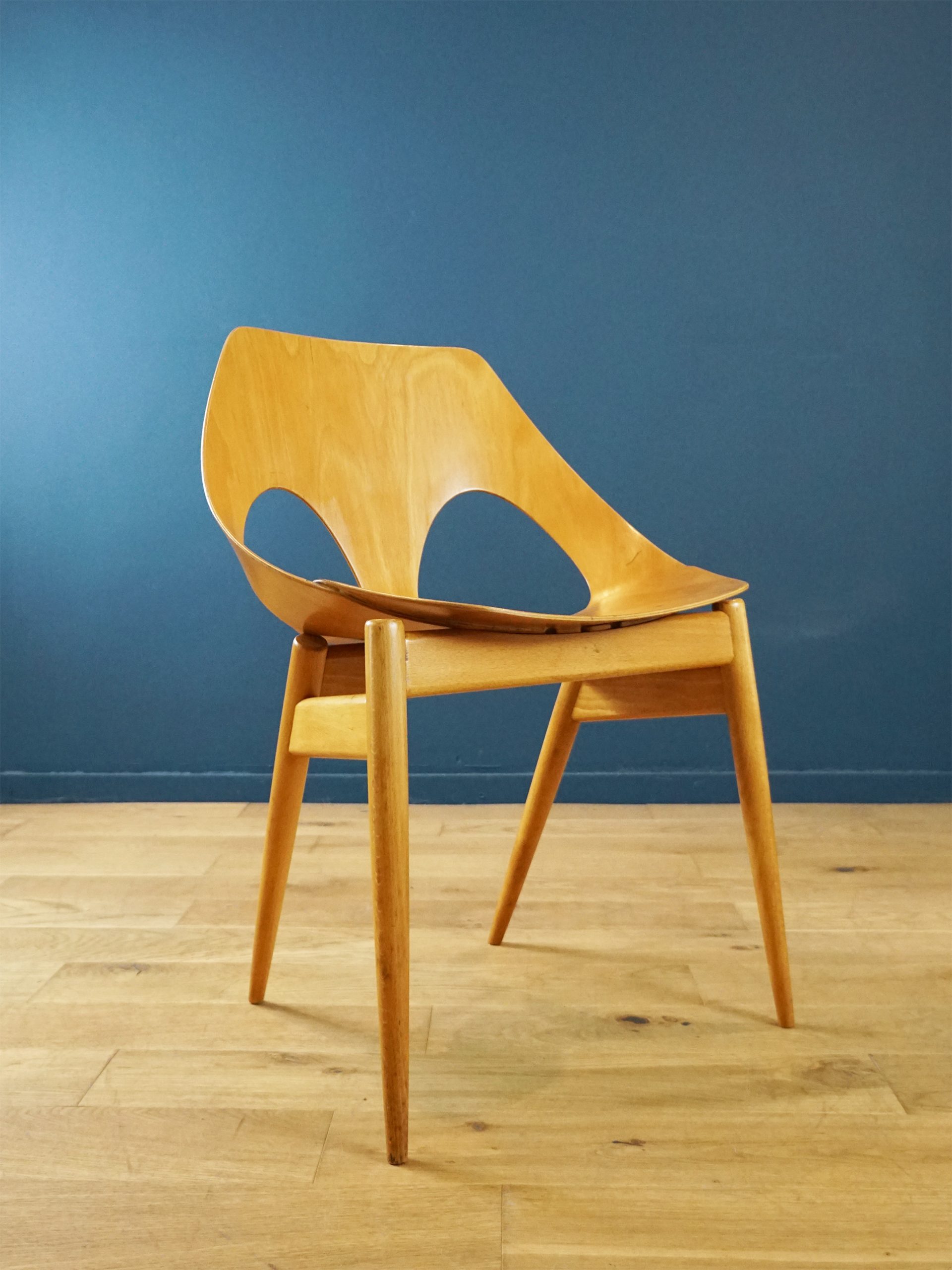
    To modern eyes, the ‘Jason’ chair can appear remarkably simple. In the early 1950s, however, the thinking behind it was anything but that. Designed by Danish architect Carl Jacobs and manufactured in Britain by Kandya, its seat and back were formed from a single, impossibly thin, flat sheet of flexible plywood, cut, bent and interlocked to create an extraordinarily economical three-dimensional structure.

    Bent plywood itself was not new at the time. Designers had already explored its possibilities, and around the same period chairs such as Arne Jacobsen’s Ant used layers of veneer glued and moulded under pressure to create rigid curved shells. The Jason approached the material differently. Rather than moulding plywood permanently into its finished form, Jacobs exploited the flexibility of a thin flat sheet. Its carefully calculated shape allows it to bend around itself, with the two sides meeting and interlocking beneath the seat. The resulting curves give the material strength and rigidity while retaining enough flexibility to make the chair almost inconceivably comfortable.

    That achievement becomes even more impressive when considered in the context of how furniture was designed at the time. Today, a shape like this could be developed using computer-aided design, adjusted repeatedly on screen and transferred directly to CNC machinery for precise cutting. Jacobs had no such tools. The relationship between a flat sheet and the complex three-dimensional form had to be conceived, drawn and ultimately proven through multiple physical prototypes. Every curve and cut had consequences, and even the distinctive openings in the back were carefully resolved to allow another chair to pass through them when the chairs were stacked.

    This is perhaps what makes the C2 Jason so fascinating. Its complexity almost completely disappears once the chair is assembled. The wooden frame is similarly restrained, leaving the sweeping plywood form to do most of the visual and structural work. What appears at first to be an extremely simple chair is actually an ingenious piece of engineering, using remarkably little material and including almost nothing without purpose. At a time when much British furniture still relied upon relatively conventional construction, the Jason must have appeared strikingly modern.

    The design also captures something particularly interesting about post-war furniture. New materials and manufacturing techniques were allowing designers to reconsider what familiar objects needed to be. A chair no longer necessarily required a conventionally constructed seat and separate back. Jacobs instead treated a flat sheet almost as if it were a textile, cutting and folding it until the material itself became the structure. The Jason’s apparent simplicity was not the absence of design, but the result of an unusually complex design problem being resolved with remarkable clarity.

    This particular C2 retains its older, less commonly encountered white Kandya label, another small but important part of the chair’s originality. Its original surfaces, marks and signs of use remain, a testament to both the quality of its construction and the longevity of a design now more than seventy years old. Rather than erase that history, the chair has simply been carefully cleaned and polished, allowing the original wood to shine again. Sometimes preservation means knowing when restoration is necessary. Just as importantly, it means knowing when to leave a remarkable piece of design alone.

  • Unusual Fat Lava Vases Found in Lisbon

    Unusual Fat Lava Vases Found in Lisbon

    One of the things we enjoy most about sourcing vintage furniture and interiors is that the story rarely ends when the purchase is made.

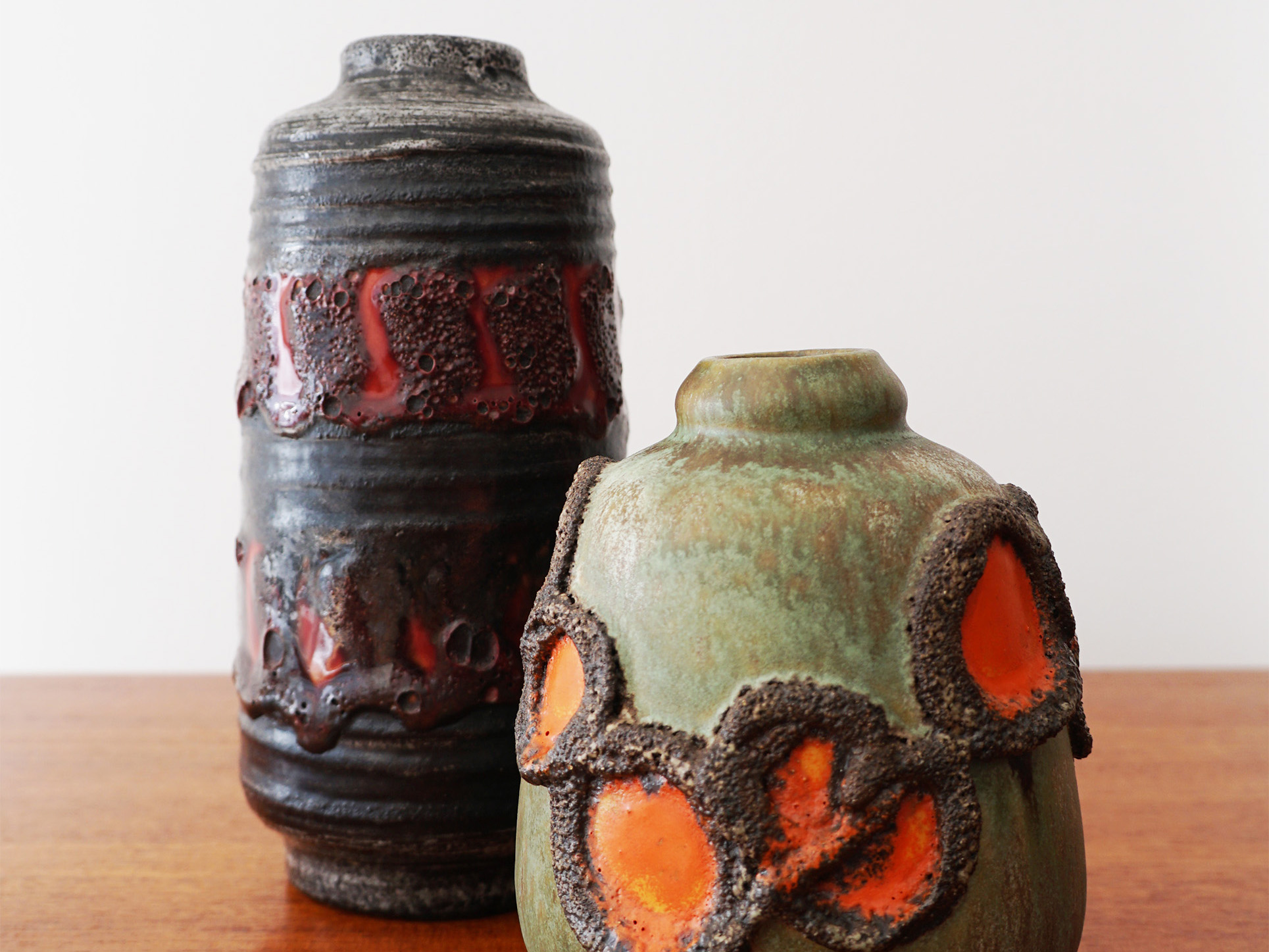
    These two ceramic vases were discovered during a recent trip to Lisbon. Bought together from a vintage dealer who told us they had come from the same source, they initially appeared to be a typical pair of 1970s Fat Lava ceramics. It was only when we started researching them that the story became far more interesting.

    What is Fat Lava?

    Fat Lava is the collector’s term commonly used to describe a style of ceramic production that flourished during the 1960s and 1970s. Characterised by heavily textured glazes, volcanic surfaces and bold colours, Fat Lava pottery became one of the defining design movements of post-war Europe.

    Most collectors immediately associate Fat Lava with West Germany, where factories such as Scheurich, Bay Keramik and Carstens produced millions of pieces for export across Europe and beyond.

    But the story is slightly more complicated than that.

    The East German Vase

    The smaller of the two vases carries an East German export mark on the base.

    This was an unexpected discovery. Like many people, we had always associated Fat Lava almost exclusively with West German production. Yet during the Cold War years, factories in East Germany were also producing ceramics for export markets across Europe.

    The vase bears the mark of Strehla, an East German pottery manufacturer that exported extensively during the 1960s and 1970s. While separated by the Iron Curtain, East German factories still sold goods abroad in order to earn valuable foreign currency.

    As a result, East German ceramics found their way into homes across Europe, where they often sat alongside pieces from West Germany with little thought given to the political divide that existed at the time.

    The Mystery Vase

    The taller vase remains something of a puzzle.

    Its dramatic red and black volcanic glaze is unmistakably of the period. The form, proportions and surface texture place it firmly within the Fat Lava tradition, yet the unusual raised marks on the base do not match anything we have encountered before.

    Research suggests it is likely German, and quite possibly West German, but the manufacturer remains uncertain. The raised symbols appear to be moulded into the base rather than added as a conventional pattern number, making identification difficult.

    Sometimes vintage objects give up their secrets quickly. Sometimes they don’t.

    Why We Love Vintage

    There is a tendency to think that sourcing vintage is simply a matter of buying and selling objects.

    In reality, it is often an ongoing process of discovery.

    A pair of vases purchased because they looked good together became a small lesson in Cold War history, European manufacturing and the way design crossed political borders during a divided era.

    Whether these two pieces originally sat side by side in a Lisbon home or only met later in life, we’ll probably never know.

    What we do know is that nearly fifty years after they were made, they are still provoking questions, starting conversations and reminding us why vintage objects are often far more interesting than new ones.

  • Restoring a Morris of Glasgow ‘Cumbrae’ Coffee Table

    Restoring a Morris of Glasgow ‘Cumbrae’ Coffee Table

    Founded in 1884, Morris of Glasgow built its reputation on carefully made furniture that balanced evolving design with enduring craftsmanship. Today, its mid-century work is receiving renewed attention, as collectors recognise the quiet confidence and material quality.

    This coffee table forms part of the firm’s Cumbrae range, a confident example of British mid-century modern design. Clean lines, tapered forms and carefully judged surfaces were designed for everyday domestic interiors rather than theatrical display, a quality that feels increasingly relevant today.

    At first glance, the table retains all the hallmarks of the range: tapered legs, a gently formed edge, and a slim, well-judged profile that feels both practical and elegant. It is a design that relies heavily on proportion and surface quality, with the tabletop acting as the visual anchor of the whole piece.

    Unfortunately, that surface had suffered significant damage before the table arrived at the workshop. A previous owner had attempted to sand the top back, cutting straight through the original veneer in multiple areas. Once veneer is breached in this way, it cannot be disguised or repaired invisibly; the integrity of the surface is lost, and further sanding only compounds the problem.

    In this case, the only responsible option was to re-veneer the tabletop entirely. A new veneer was carefully selected to match the character and grain of the original as closely as possible, before being laid and finished to sit naturally alongside the existing frame. The remainder of the table was then fully refinished, bringing cohesion back to the piece without over-restoring or stripping away its age.

    What this project illustrates particularly well is how unforgiving mid-century veneered furniture can be when handled without the right experience. These pieces were never designed to be aggressively sanded; their refinement lies in thin, carefully applied veneers and subtle edge details that are easily destroyed with even a small mistake.

    The finished table once again reads as it should, balanced, calm and confident in its design. More importantly, it serves as a reminder that restoration is not about intervention for its own sake, but about understanding where restraint ends and necessary action begins. Done properly, it allows well-designed furniture like this to continue doing what it was made to do, without erasing the evidence of its past.

  • Saving a Rare G Plan Model 4060 Sideboard

    Saving a Rare G Plan Model 4060 Sideboard

    Designed by Ib Kofod-Larsen for G Plan’s Danish range, the Model 4060 sideboard stands among the most recognisable and collectible pieces of British mid-century modern furniture.

    Produced in the early 1960s, it represents a moment when E. Gomme Ltd stepped beyond its mainstream output and embraced a more authentically Scandinavian design language — lighter in proportion, more sculptural in structure, and quieter in its confidence. The Danish range looked unmistakably modern, yet unmistakably British in its build quality and material integrity. Today, the 4060 is widely regarded as one of the defining pieces of that short-lived but highly influential collaboration.

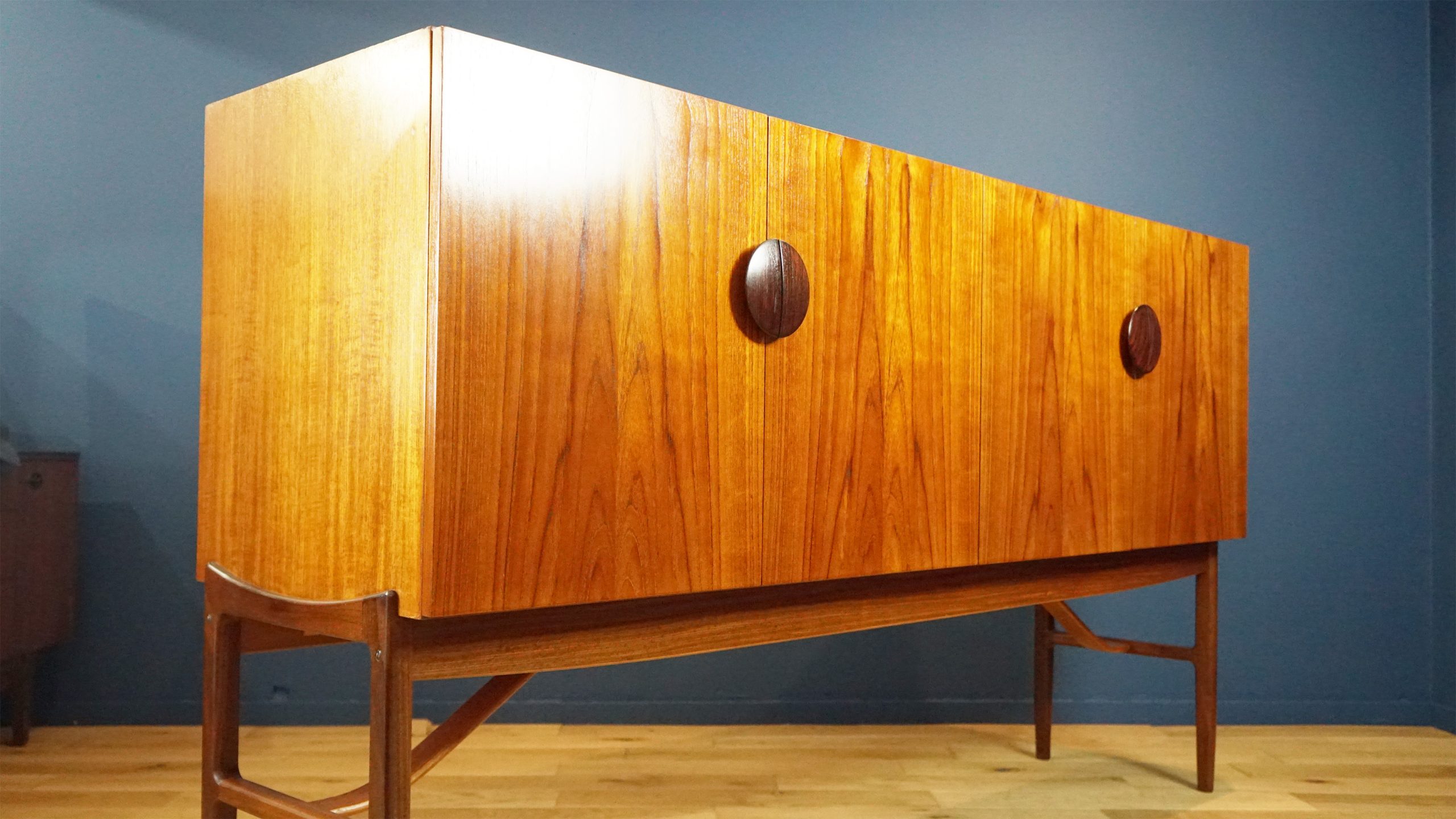
    Part of what makes this example so compelling is its rarity, particularly in Cornwall, where pieces from the Danish range surface far less frequently than in major urban centres. The design itself is instantly recognisable: four large doors with bold round rosewood handles, elevated on elegantly shaped legs and distinctive curved stretchers. Behind one of the doors sits a set of beautifully proportioned internal drawers, a quiet but telling detail that speaks to the intelligence of Kofod-Larsen’s design. The proportions are balanced and architectural, allowing the rich teak veneers to read as the true focus of the piece. In many ways, the 4060 embodies his design philosophy — functional, graceful, and timeless.

    What elevates this particular sideboard beyond a desirable example to an exceptional one is the survival of its original G Plan promotional poster. This was carefully removed, preserved, and later reattached in its original position inside the door. Such ephemera is rarely preserved at all, as most were removed, lost, or damaged over decades of use. Its presence provides a direct link back to the piece’s original context as a new, aspirational product in the early 1960s British home. It adds cultural and historical value far beyond the sideboard’s visual appeal alone.

    Given both its rarity and provenance, the restoration of this piece was guided by a preservation-first approach. Rather than seeking to make it look ‘as new’, the priority was to stabilise, conserve, and enhance what already existed. Original surfaces were treated with care, wear patterns were respected, and interventions were kept to the minimum necessary to ensure longevity. The aim was not transformation, but continuity — allowing the character of age, use, and history to remain legible while restoring clarity, warmth, and balance to the teak.

    Projects like this underline why the Danish range continues to command such admiration among collectors. These were not mass-market pieces, but carefully considered designs that pushed G Plan into a more international design conversation. The Model 4060 remains a testament to that ambition — a piece that feels as relevant today as it did when first introduced. At Casta Blue, work on objects of this calibre is approached with both respect and restraint, ensuring that rare, well-designed furniture is preserved rather than overwritten, and allowed to continue its story with integrity.

  • 1959 Beautility ‘Brussels’ Sideboard Restoration

    1959 Beautility ‘Brussels’ Sideboard Restoration

    Dating from 1959, this stunning sideboard forms part of Beautility’s Contemporary Range, a period when British furniture design was embracing lighter forms and a more modern European influence. Known as the Brussels Sideboard, it reflects a shift away from heavier post-war styling towards cleaner, more architectural proportions, while still retaining warmth through tone, veneer and detail.

    Beautility’s work from this era sits in an understated but important design space. This example retains its original Beautility Dining Room Furniture label and aligns with original catalogue references from 1959. Original brochures, sourced with the help of Early History of Beautility, provide a valuable snapshot of the piece in its original context.

    Because of the history of this piece, the restoration was guided by a preservation-first approach rather than an attempt to make it appear new. The most significant issue was the top surface, which had been over-sanded by a previous owner, cutting through the original veneer. As the original surface could not be saved, the top was re-veneered and then carefully blended to sit naturally alongside the original body of the piece.

    Beyond that necessary intervention, the rest of the sideboard was left intentionally restrained. Gentle wear, softened edges and subtle tonal variation were preserved rather than erased. The aim was to maintain the piece’s age, character and authenticity, allowing it to read as a well-cared-for original rather than a heavily reworked reproduction. The result is a sideboard that remains true to its period, its maker and its story, carrying both its original design intent and the quiet evidence of time.

    At Casta Blue, restoration is not intended to produce ‘as new’ pieces, but to act as a careful continuation, preserving what deserves to remain and ensuring that good design endures with integrity.

  • G Plan Model 4305 Dining Table, A Transitional Piece in Mid-Century Modern Furniture

    G Plan Model 4305 Dining Table, A Transitional Piece in Mid-Century Modern Furniture

    This dining table is a rare early example of G Plan’s Tola range, listed as Model 4305 in early 1960s catalogues. Produced by E. Gomme Ltd, it dates from a pivotal moment in British furniture history, when post-war design was shifting away from traditional domestic styling towards a more modern aesthetic shaped by Scandinavian and European influence.

    E. Gomme’s contemporary brand, G Plan, was created to offer coordinated modern furniture for a new generation of homeowners, refining its identity through cleaner lines, simpler forms and a more architectural presence. The Model 4305 sits squarely within this transition. It retains the solidity and engineering of earlier E. Gomme production, while clearly pointing towards the cleaner, more confident mid-century modern identity that would later define G Plan.

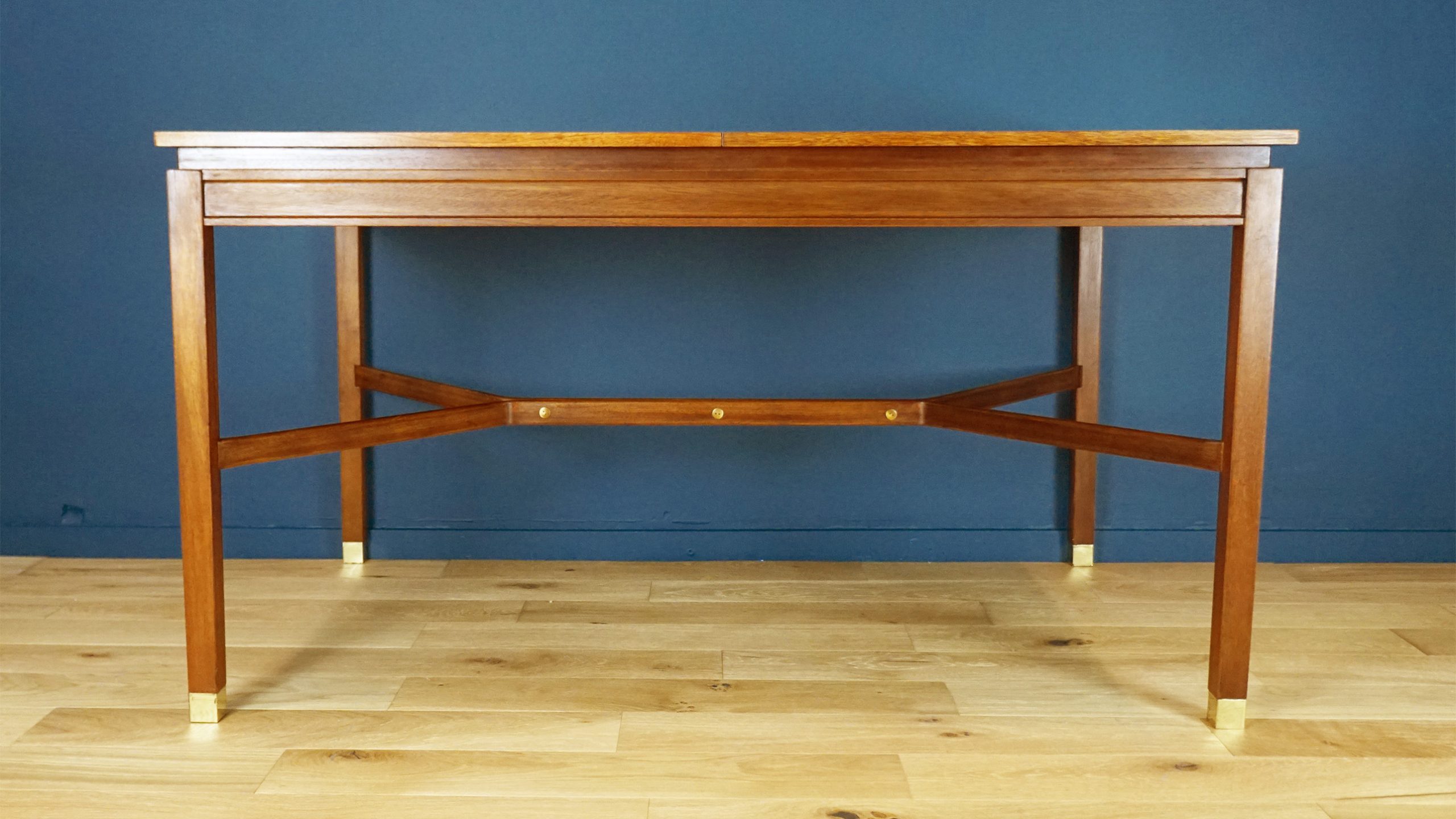
    Several design details distinguish this model. The table features an unusual bent-wood stretcher, shaped into a curved structural brace, introducing a sculptural quality rarely seen in more conventional British dining tables of the period. This is paired brass fixings, adds a subtle metallic accent that reflects G Plan’s growing interest in mixed materials. The table also bears an early E. Gomme ‘G Plan’ gold stamp, associated with the emerging brand’s first years of production.

    This particular example underwent a complete restoration due to significant historic damage. The tabletop had developed severe water marking, compromising both its appearance and surface integrity. To resolve this, the table was fully stripped and refinished, removing degraded coatings and restoring clarity to the grain.

    The contrast between the pre-restoration condition and the finished result highlights the difference between superficial refurbishment and design-led conservation. Rather than attempting to make the table appear factory-new, the work focused on material honesty, preserving the warmth, tone and authenticity that gives mid-century modern furniture its enduring appeal.

    What ultimately sets the Model 4305 apart is not only its rarity but its historical position. It represents a moment when British manufacturers were negotiating identity, modernity and international influence, helping to define what would become the classic G Plan aesthetic. At Casta Blue, pieces like this are valued not only for their beauty, but for what they reveal about design evolution, manufacturing history and material craft.

  • Reviving a Compact but Classic White & Newton Cabinet

    Reviving a Compact but Classic White & Newton Cabinet

    This small but distinctive bedside cabinet was made by White & Newton, a British manufacturer whose reputation has grown significantly in recent years. Once relatively obscure outside specialist circles, the brand is now increasingly recognised for producing some of the most refined and distinctive furniture of the mid-century modern period.

    Founded in Portsmouth, White & Newton became known in the 1950s and 1960s for their confident use of teak, sculptural detailing and expressive modern forms. Their designs often carried a lighter, more characterful touch than some of their larger competitors, combining strong material quality with textured drawer fronts, bold proportions and playful surface detail. As interest in British mid-century modern furniture has deepened, White & Newton pieces have become increasingly sought after, with collectors now viewing the brand as a standout of the era rather than a footnote.

    When this cabinet arrived in the workshop, it was in very poor condition. The top surface was heavily worn, with widespread finish failure and long-standing marks that obscured the grain almost entirely. Years of neglect had left the piece dull, tired and visually compromised, the kind of furniture many would dismiss as beyond saving.

    The cabinet was carefully stripped back to remove degraded finishes and accumulated damage, allowing the original wood to be properly assessed. From there, the surfaces were refinished, restoring clarity to the grain while preserving the character and age that give mid-century modern furniture its authenticity.

    The transformation lies not in making the piece look “new”, but in allowing its original design to be seen again. Once the damage and discolouration were removed, the cabinet’s proportions, detailing and material quality re-emerged. What had previously appeared tired and disposable now feels purposeful, warm and design-led.

    Well-made pieces from this era were built with materials and construction methods that lend themselves to restoration, and with the right approach, even heavily worn examples can be returned to meaningful, long-term use. In this case, the cabinet reflects the growing recognition of White & Newton as a maker of real character, and demonstrates how thoughtful restoration can rescue objects that might otherwise be overlooked or discarded.

  • Saving a Rare G Plan Danish Range Table

    Saving a Rare G Plan Danish Range Table

    Designed by Ib Kofod-Larsen for G Plan’s Danish range, this dining table represents a distinctive moment in mid-century modern design. Produced in the early 1960s, the Danish range introduced a more authentically Scandinavian sensibility into G Plan’s catalogue.

    Kofod-Larsen is best known for his sculptural seating and refined timber work, and his collaboration with G Plan stands out as one of the most notable Danish contributions to British commercial furniture of the period. The resulting pieces combine Scandinavian lightness with the structural discipline and practicality associated with G Plan.

    Pieces from the Danish range are now considered relatively scarce. Compared with G Plan’s more widely produced lines, this series appears to have been made in smaller numbers, often linked to higher production costs and more complex construction. As a result, original examples have become increasingly sought after by collectors of mid-century modern furniture.

    When this table arrived in the workshop, it was in extremely poor condition after years of neglect. The surface showed heavy wear and staining, with widespread finish failure that obscured the grain and dulled the character of the wood, leaving it looking tired and worthless.

    We carefully stripped the table back to remove degraded finishes and accumulated damage, then refinished to restore depth, warmth and clarity to the timber while preserving the character appropriate to a mid-century original. The goal was not to make the piece look new, but to allow the design, proportions and craftsmanship to read clearly again.

    We specifically sourced this table for a client and dedicated G Plan collector who had been searching for this exact type of piece. Today, it stands as both a functional dining table and a quiet record of a British–Scandinavian design crossover, as well as an example of how thoughtful restoration can return neglected furniture to meaningful, lasting use.